Palermo Sicily Tours: Norman Mosaics, Street Food & Baroque Splendor
Imagine standing beneath 12,000 square meters of golden Byzantine mosaics—the entire interior of Monreale Cathedral shimmering with biblical narratives told through millions of gold-leaf tesserae. Then, hours later, standing in a bustling market where vendors have sold arancini and panelle for generations, their recipes perfected over centuries. This duality defines Palermo—Sicily’s chaotic, magnificent capital where high art meets street culture, where Norman kings built palatial churches, and where every corner tells dramatic stories of conquest, fusion, and survival.
Welcome to Italy’s most complex, rewarding city—a place that challenges expectations and delivers experiences impossible elsewhere. While Taormina offers refined coastal elegance and Catania showcases Baroque reconstruction, Palermo provides something different: raw authenticity, cultural layers spanning Phoenicians, Romans, Byzantines, Arabs, Normans, and Spanish, all visible in architecture, cuisine, and daily life.
This isn’t about checking landmarks off a list. This is about understanding why UNESCO designated Palermo’s Arab-Norman sites as World Heritage treasures, why Sicilian street food rivals any Michelin experience in complexity and satisfaction, and why discerning travelers increasingly choose Palermo over more obvious Italian destinations.
Grand Hotel et Des Palmes: Your Art Nouveau Palace
Accommodation profoundly shapes your Palermo experience. Grand Hotel et Des Palmes, a historic five-star property on Via Roma (Palermo’s grand boulevard), offers something beyond standard luxury—genuine connection to the city’s aristocratic Belle Époque when Sicily attracted European nobility and artists seeking warm winters and exotic culture.
Former Noble Residence with Legendary Past
Originally built as a private palace for the Ingham-Whitaker family (British merchants who made fortunes in Sicilian wine), the property became a hotel in 1874 and quickly established legendary status. Richard Wagner composed here, Raymond Chandler set scenes here, and it hosted everyone from European royalty to American writers seeking Sicilian inspiration.
Today, the hotel preserves this heritage while offering contemporary five-star service:
- Majestic lobby with frescoed ceilings: Walking into soaring spaces adorned with period artwork immediately transports you to Palermo’s golden age
- Art Nouveau Winter Garden: The hotel’s architectural crown jewel—an enclosed garden space showcasing Liberty style (Italian Art Nouveau) with iron-and-glass construction, period furniture, and lush plantings
- Sumptuous halls with antiques: Every corridor features carefully curated artwork, refined fabrics, and furniture honoring the building’s noble origins
- Double Deluxe City View rooms: Your accommodations overlook Palermo’s vibrant streets—morning espresso comes with people-watching as locals begin their day
Staying two nights allows proper immersion—time to experience Palermo at different hours, when morning markets bustle, when afternoon siesta quiets streets, when evening passeggiata fills boulevards with elegantly dressed locals.
Strategic Via Roma Location
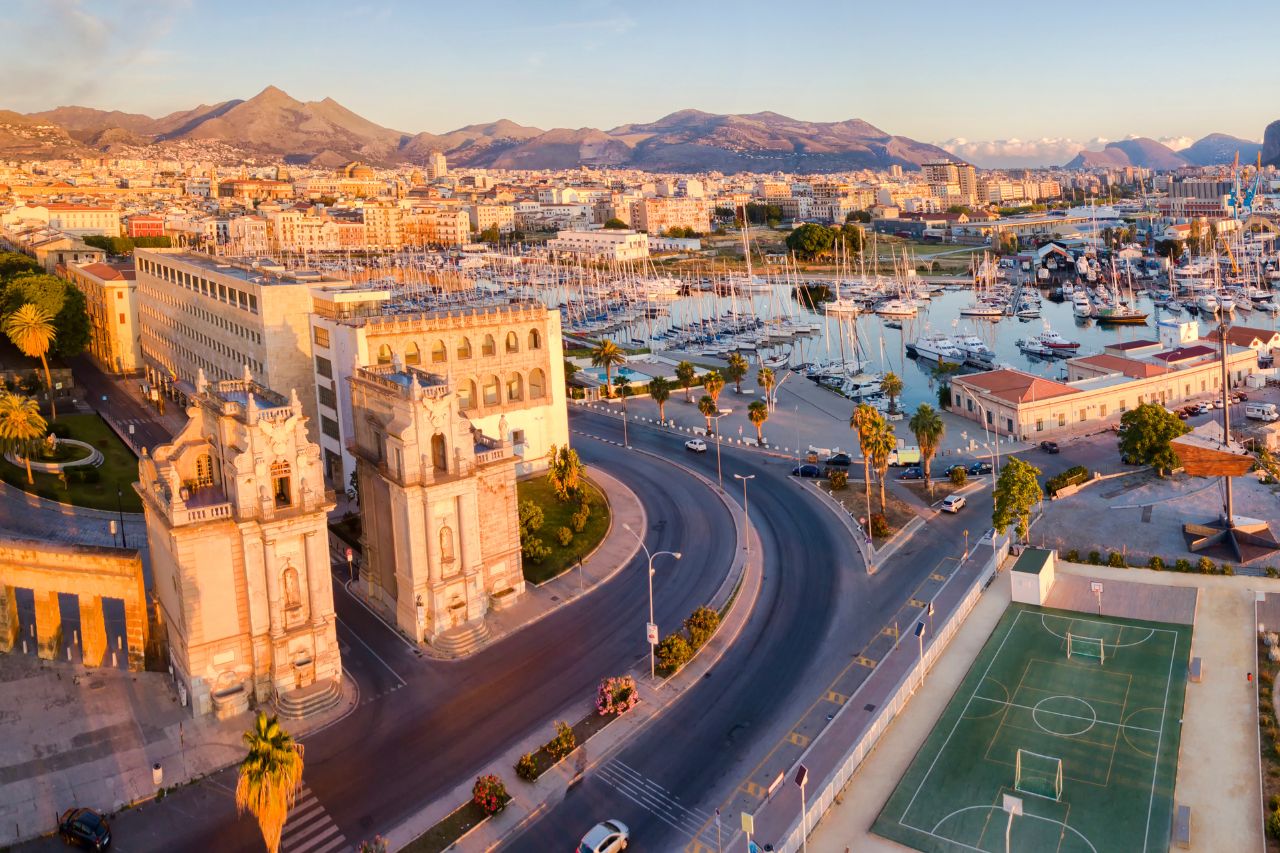
Your hotel’s position on Via Roma—the wide boulevard built in early 1900s connecting port to mountains—means walking access to major sites: Quattro Canti baroque intersection, Teatro Massimo opera house, historic markets, and the Norman Palace. Yet the location also offers immediate immersion in authentic Palermo street life rather than tourist-zone isolation.
Street Food Art: Culinary Walking Tour Through Old Cassaro
Palermo’s street food isn’t casual eating—it’s culinary art refined over millennia, with recipes showing clear Arab, Norman, Spanish, and indigenous Sicilian influences. Your 4-hour afternoon culinary walking tour with private guide reveals why food writers consider Palermo among the world’s greatest street food cities.
Tasting Iconic Sicilian Specialties
Walking through the Old Cassaro (Palermo’s ancient main street, dating to Phoenician times), your guide leads you to vendors, markets, and small shops where locals have purchased these foods for generations:
- Arancini: Rice balls the size of oranges (thus the name), stuffed with ragù, peas, and cheese, then breaded and fried—the ultimate Sicilian street food, with endless variations
- Panelle: Chickpea flour fritters, crispy outside and creamy within, typically served in sesame bread—Arab influence evident in ingredients and technique
- Crocchè: Potato croquettes with local variations including cheese, often eaten as breakfast or mid-morning snack
- Sfincione: Palermo’s signature focaccia-like pizza, topped with onions, tomatoes, breadcrumbs, and anchovies—completely different from Neapolitan pizza
- Caponata: Sweet-and-sour eggplant dish showcasing Arab influence (sweet-sour combinations), served as appetizer or side
Between tastings, your guide explains historical context—how Arab occupation (831-1072 AD) introduced rice, citrus, and eggplants; how Spanish rule brought tomatoes and chocolate; how each conqueror’s cuisine layered onto existing traditions creating the complex flavors defining Sicilian cooking.
Martorana Square: Golden Mosaics and Marzipan History
Your tour concludes in Piazza Bellini, dominated by La Martorana church (officially Santa Maria dell’Ammiraglio). Inside, 12th-century Byzantine mosaics rival those you’ll see later at Monreale—Christ Pantocrator, archangels, and Roger II receiving his crown from Christ himself, all gleaming with gold-leaf backing.
Here, your guide tells the story of Martorana fruits—marzipan shaped and painted to look like real fruit, created by nuns in the adjacent convent. Legend claims they made these to replace real fruit removed from trees by a visiting bishop, though more likely they were created as Easter gifts. Today, every Palermo pastry shop sells these edible artworks.
Palermo & Monreale: Full-Day Arab-Norman Splendor
Your 7-hour comprehensive tour with private English-speaking driver and expert guide reveals the Arab-Norman cultural fusion that makes Sicily architecturally unique—nowhere else did these civilizations create such extraordinary synthesis.
Palermo’s Norman Heritage and Baroque Drama
Beginning in Palermo proper, your guide navigates you through key sites revealing the city’s layered history:
- Quattro Canti (Four Corners): Baroque intersection where Via Maqueda crosses Via Vittorio Emanuele, each corner featuring elaborate 17th-century facades representing seasons, Spanish kings, and Palermo’s patron saints
- Norman Palace (Palazzo dei Normanni): Sicily’s oldest royal residence, begun by Phoenicians, enlarged by Arabs, transformed by Normans—now housing the regional parliament
- Palatine Chapel: Inside Norman Palace, this 12th-century marvel features Byzantine mosaics covering every surface, Arab-designed muqarnas ceiling, and Norman architecture—perfect fusion of three civilizations
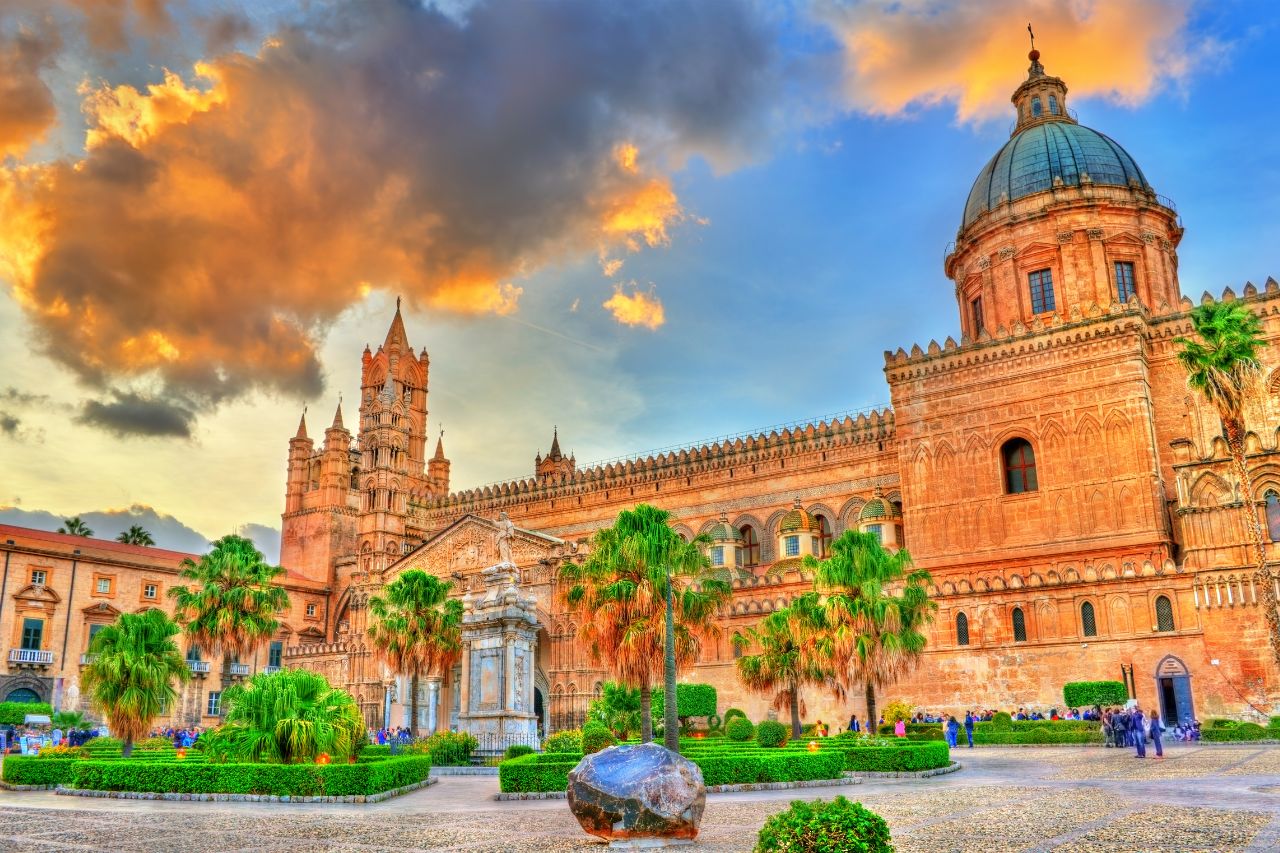
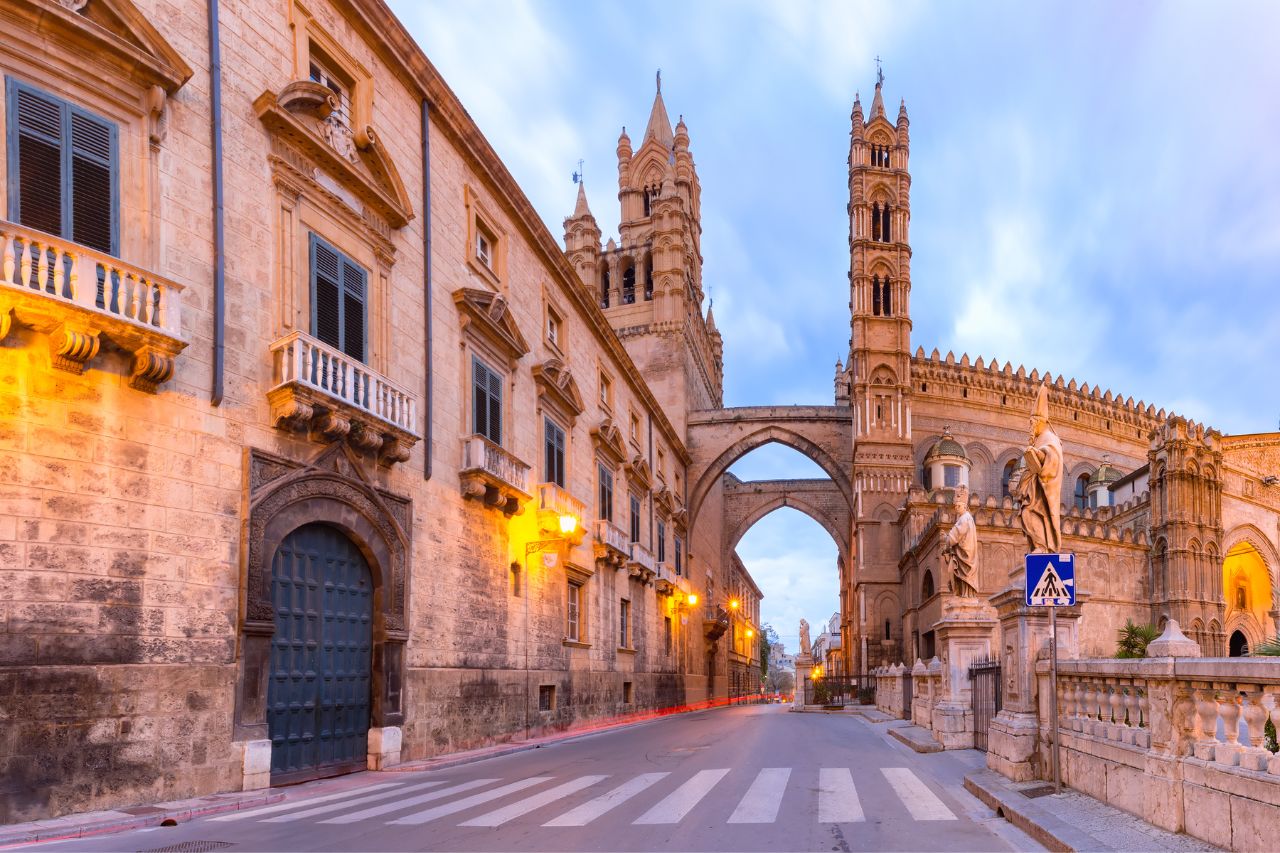
- Palermo Cathedral: Built atop a mosque (itself built atop early Christian church), showing Norman, Gothic, Baroque, and Neoclassical additions—Sicilian history in architectural form
Monreale Cathedral: The Ultimate Norman Achievement
After leisurely lunch (at your expense, allowing menu flexibility), you drive up mountain slopes to Monreale, overlooking Palermo and the sea beyond. The cathedral here represents the pinnacle of Norman artistic achievement—perhaps the most impressive medieval church in Europe.
Walking inside creates immediate astonishment. The entire interior—over 12,000 square meters—shimmers with Byzantine-style golden mosaics depicting Old Testament narratives, Christ’s life, and saints. Unlike the fragmentary mosaics surviving in most medieval churches, Monreale’s remain nearly complete, offering rare comprehensive view of medieval biblical interpretation.
Key highlights include:
- Christ Pantocrator in apse: Massive image of Christ dominating the space, his expression simultaneously severe and compassionate
- Creation narrative: God creating universe shown in sequential panels like medieval comic strip
- Noah’s Ark: Detailed depiction including individual animals
- Gold-leaf technique: Millions of tiny glass tesserae backed with gold leaf create that distinctive shimmer—technology perfected in Byzantium, executed by imported craftsmen
The adjacent Benedictine cloister provides peaceful contrast—delicate columns (each uniquely decorated with geometric patterns and mosaics) surrounding garden courtyard, representing Arab architectural influence on Norman structures.
Journey to Sciacca: Erice Medieval Charm & Segesta Greek Grandeur
Your departure from Palermo transforms into a 7-hour cultural journey visiting two dramatically different yet equally compelling sites en route to your next destination.
Erice: Medieval Hill Town Above the Clouds
Erice perches at 750 meters atop Mount Erice, often shrouded in clouds that give the medieval town ethereal atmosphere. Walking its cobblestone streets, you’re surrounded by remarkably preserved Norman castle walls, Gothic churches, and stone houses little changed in centuries.
The town’s fame extends beyond architecture to its pastry tradition. Your stop at a renowned pastry shop lets you taste creations like:
- Genovesi: Fried pastries filled with custard
- Mustazzoli: Traditional cookies with honey and spices showing Arab influence
- Frutta Martorana: Marzipan fruits similar to those in Palermo
From Erice’s viewpoints, on clear days you see Tunisia across the Mediterranean—visual reminder of Sicily’s strategic position at civilization’s crossroads.
Segesta: Perfectly Preserved Greek Temple
Descending from Erice, you reach Segesta—one of the Mediterranean’s most spectacular ancient sites. The Doric temple, built around 420 BC by the indigenous Elymian people (influenced heavily by Greeks), sits alone on a hilltop in stunning preservation.
What makes Segesta extraordinary is its perfect intact state—the temple was never completed (note the unfluted columns and lack of roof), yet this incompleteness somehow enhances its beauty. The isolated location, with temple silhouetted against mountains and sky, creates images you’ll remember long after returning home.
Higher on the mountain, the ancient amphitheater offers both archaeological interest and stunning views toward the Tyrrhenian Sea. Your private local guide provides historical context about the Elymians, their conflicts with Carthaginians and Greeks, and Segesta’s ultimate fate under Roman rule.
Following the Segesta visit and leisure lunch, your driver continues to Sciacca and the magnificent Verdura Resort, completing your Sicilian journey’s next chapter.
Planning Your Perfect Palermo Experience
Pre-Trip Essentials:
- ✓ Book 3-4 months ahead for peak seasons (April-June, September-October)
- ✓ Pack comfortable walking shoes: Palermo requires significant walking on uneven streets
- ✓ Light layers essential: Churches can be cool even when streets are hot
- ✓ Modest attire for churches: Shoulders and knees covered for cathedral visits
- ✓ Cash useful: Street food vendors often prefer cash
- ✓ Appetite important: Street food tour includes substantial tastings
- ✓ Camera essential: Monreale mosaics create extraordinary photo opportunities
Best Times to Visit Palermo:
- Spring (April-May): Perfect weather, Easter celebrations, fewer crowds, ideal for outdoor exploration
- Early Fall (September-October): Still warm, harvest season, cultural events, comfortable temperatures
- Winter (November-March): Mild temperatures, very few tourists, authentic local life, occasional rain
- Summer (June-August): Very hot (often 90°F+), locals vacation at beaches, some businesses close for August
Frequently Asked Questions: Palermo Tours
Is Palermo safe for tourists?
Yes, Palermo is generally safe for tourists, especially in central areas and with reputable guides. Like any large city, maintain normal precautions—watch belongings in crowded markets, avoid deserted areas at night. Your private guides and drivers provide additional security and local knowledge ensuring safe, enriching experiences.
How many days should I spend in Palermo?
We recommend 2-3 nights minimum to appreciate Palermo’s complexity—street food tour, Monreale excursion, and at least one day for spontaneous market discoveries or additional sites like Capuchin Catacombs or modern art at Palazzo Abatellis. However, Palermo rewards longer stays for those wanting deeper immersion.
What makes Monreale Cathedral special?
Monreale features the largest cycle of Byzantine mosaics outside Constantinople—over 12,000 square meters of nearly complete 12th-century golden mosaics depicting biblical narratives. Unlike fragmentary mosaics surviving elsewhere, Monreale preserves comprehensive medieval artistic vision, making it among Europe’s most important medieval monuments.
Is Palermo street food really that good?
Absolutely. Palermo ranks among the world’s great street food cities alongside Bangkok, Istanbul, and Mexico City. The Arab-Norman culinary fusion, centuries of refinement, and intense local pride create street foods as complex and satisfying as restaurant meals—different experience entirely, not lesser quality.
How does Palermo compare to other Sicilian cities?
Palermo offers urban energy, cultural complexity, and architectural diversity that smaller Sicilian cities lack. Taormina provides refined resort atmosphere, Catania showcases Baroque unity, Syracuse offers Greek archaeology—but Palermo alone provides complete Sicilian cultural spectrum in one location, though admittedly with more chaos and less polish.
Can I visit Palermo without speaking Italian?
Yes, especially with our private English-speaking guides and drivers. While Palermo sees fewer English speakers than Rome or Venice, your guides navigate all interactions, explain menus, handle purchases, and provide cultural context. This support transforms potential language barriers into seamless cultural education.
What’s included in the Grand Hotel des Palmes experience?
Beyond luxurious Double Deluxe City View rooms with breakfast, the hotel offers historic ambiance—frescoed ceilings, Art Nouveau Winter Garden, period antiques, sumptuous halls—connecting you to Palermo’s aristocratic Belle Époque when European nobility wintered here and artists sought Sicilian inspiration.
Begin Your Palermo Sicilian Journey Today
Palermo isn’t just visited—it’s experienced, challenged, and ultimately embraced for its authentic complexity. From Byzantine mosaics shimmering with gold to street vendors frying panelle using century-old techniques, every moment reveals Sicily’s dramatic soul.
Whether you’re drawn by Norman architectural genius, street food artistry, ancient Greek temples, or simply authentic Italian culture beyond tourist circuits, we’re here to make it flawless.
Start Designing Your Palermo Experience
Luxury Italian Escape
📧 Email: info@luxuryitalianescape.com
📞 Phone: +1 (305) 630-8433
📱 Instagram: @luxuryitalianescape
🌐 Website: www.luxuryitalianescape.com